
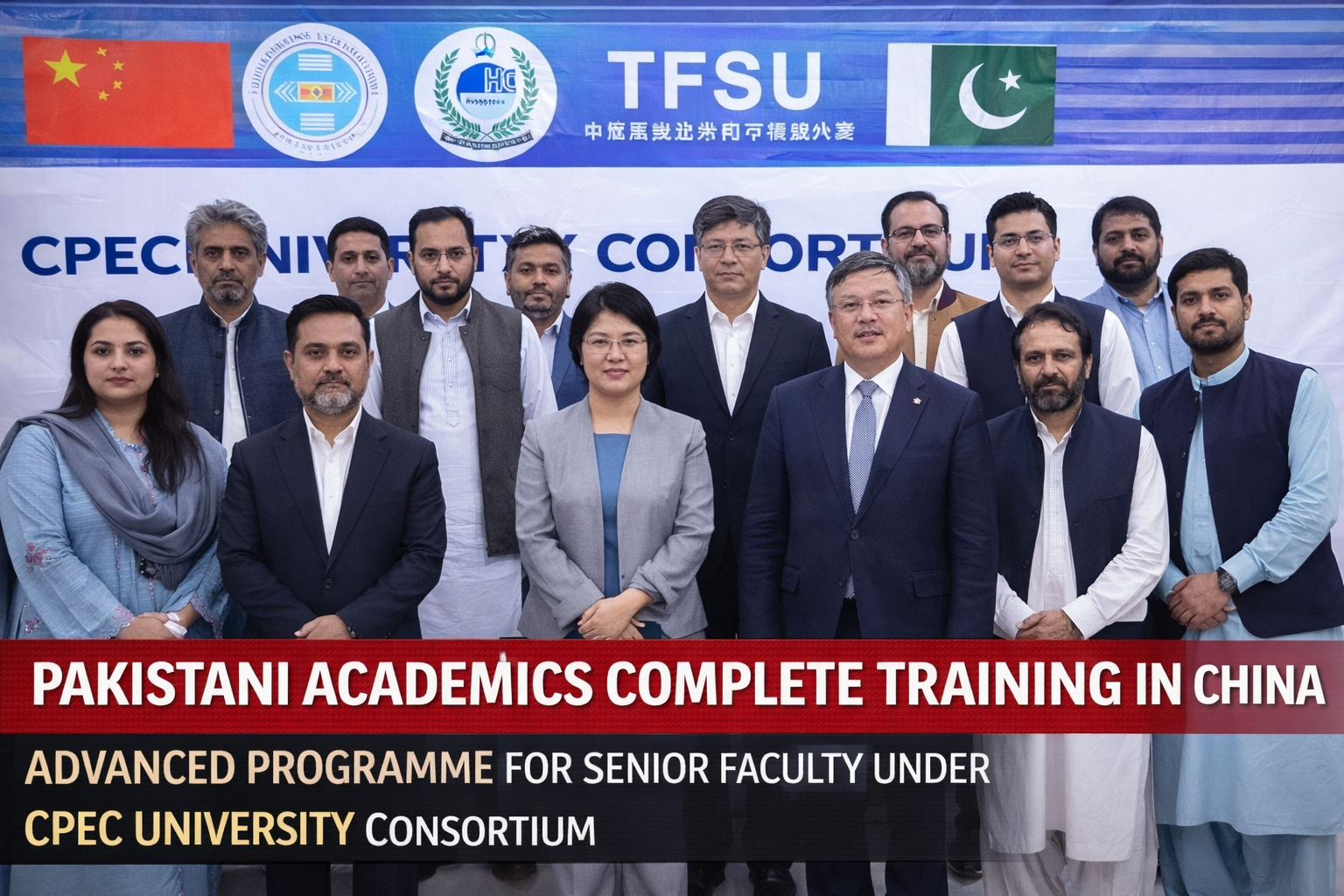
The second Advanced Training Programme for senior academics from Pakistani higher education institutions concluded recently at Tianjin Foreign Studies University (TFSU), China, marking another milestone in academic collaboration under the China-Pakistan Economic Corridor (CPEC) University Consortium.
The two-week programme hosted 24 academic staff members from Pakistani universities and formed part of a broader effort to strengthen cooperation between higher education institutions of the two countries. The CPEC Consortium of Universities, a collaborative platform established jointly by the Higher Education Commission (HEC), Pakistan, and the China Association of Higher Education (CAHE), aims to enhance academic cooperation and knowledge exchange under the CPEC unit of HEC.
The opening ceremony was graced by President of TFSU, Ms. Li Yingying; Vice President of TFSU, Mr. Zhu Pengxiao; and Director General of the Global Engagement Division at HEC Pakistan, Ms. Aayesha Ikram. Addressing the participants, Ms. Li Yingying described the programme as an enriching “journey of exploration” and highlighted the diverse learning experiences it offered.
“You have not only explored cutting-edge areas such as AI-empowered education and examined the inheritance of the ‘craftmanship spirit’, but also experienced the pulse of ‘intelligent manufacturing’ in China,” she remarked. She expressed the hope that participants would apply their learning to become pioneers in the digital transformation of education, contribute to high-quality development under CPEC, and act as ambassadors for China-Pakistan people-to-people connectivity.
Ms. Li Yingying also noted that the programme was officially incorporated into commemorative activities marking the 75th anniversary of the establishment of diplomatic relations between China and Pakistan, reflecting the significance of the training within the broader bilateral partnership.
Speaking at the ceremony, Ms. Aayesha Ikram underlined the importance of the programme for Pakistan’s higher education system. She explained that HEC, as an autonomous regulatory and funding body, is mandated to steer the development, quality enhancement, and international engagement of Pakistani universities.
“Our overarching objective is to ensure that universities play a transformative role in national development by producing skilled graduates, impactful research, and meaningful innovation,” she said. She further outlined that HEC’s policy is guided by three interlinked priorities: inclusion and access; academic quality; and relevance and impact.
Ms. Ikram also highlighted that the conduct of the second advanced training programme within a span of two months demonstrates the strength, trust, and forward momentum of academic cooperation between Pakistan and China.
Earlier, the programme was inaugurated by Deputy Secretary-General of the China Association of Higher Education, Ms. Gao Xiaojie, who emphasised the long-standing friendship and partnership between the two countries. She highlighted the role of the CPEC University Consortium in promoting collaborative research, capacity building, and talent development in key areas such as AI, international engineering, cultural modernization, and regional studies.
Representing the cohort of trainees, Dr. Abdul Samad of Loralai University expressed gratitude for the training programme. He described it as an enriching experience that provided valuable insights into digital transformation in Chinese higher education and offered a unique perspective on innovative teaching and research practices.
The completion of this second Advanced Training Programme under the CPEC University Consortium reinforces ongoing efforts to deepen academic collaboration between Pakistan and China, ensuring that higher education institutions in both countries continue to benefit from shared knowledge and international engagement.
About The Author