
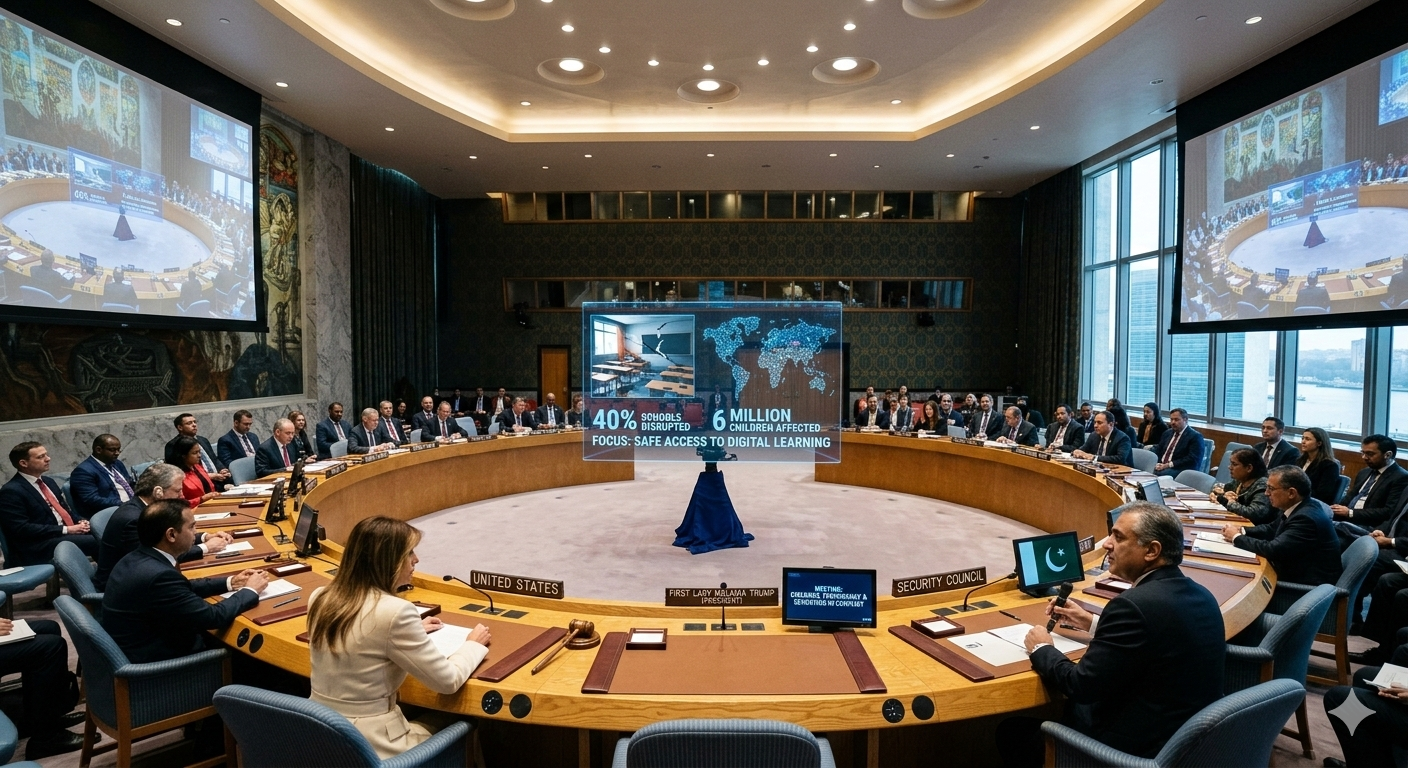
In a session marked by both high-stakes diplomacy and historic firsts, Pakistan has issued a powerful call to the global community: the only true way to protect a child’s right to education is to end the wars that steal their future.
Speaking before the United Nations Security Council (UNSC) on Monday, March 2, 2026, Ambassador Asim Iftikhar Ahmad, Pakistan’s Permanent Representative, delivered a sobering assessment of the state of global education in conflict zones.
The debate, titled “Children, Technology, and Education in Conflict,” was presided over by US First Lady Melania Trump, marking the first time in history a sitting American First Lady has held the gavel at the Security Council.
A Generation Under Fire
Ambassador Ahmad’s address centered on the systemic destruction of childhood in territories under foreign occupation and active warfare. He highlighted that for millions of children in places like Palestine and Jammu and Kashmir, the traditional classroom has been replaced by a landscape of “rubble and chaos.”
“Education systems already fragile have been pushed to the brink of collapse,” the Ambassador warned, noting that schools are frequently militarized or destroyed, while digital networks meant to be a lifeline are often the first to be disrupted.
The Double-Edged Sword of Technology
A key focus of the debate was the role of technology in bridging the educational gap for displaced children. While Ambassador Ahmad welcomed the First Lady’s “Fostering the Future Together” initiative a global coalition aimed at using innovation to enhance child welfare, he offered a word of caution.
While digital platforms can provide remote learning for isolated children, Ahmad stressed that technology must be managed with robust safeguards. Without them, the digital world can expose vulnerable children to misinformation, hate speech, and exploitation. He called for:
- Closing the digital divide through resilient infrastructure.
- Affordable connectivity specifically for girls and children with disabilities.
- Integrating child protection into the very design of digital learning
An Obligation Beyond Politics
The session took place against a backdrop of intense regional tension in the Middle East, including recent reports of strikes affecting schools. Despite the complex political climate, the Pakistani envoy reminded the Council that protecting children is a moral imperative that transcends borders.”
While conflicts persist, we have an obligation to ensure that no child’s future is extinguished by circumstances beyond their control,” Ahmad concluded. He argued that education is not merely a service but a “stabilizing force” that prevents radicalization and fosters long-term hope.
About The Author