
ISLAMABAD – A comprehensive new study has revealed the intricate landscape of how education is funded in Pakistan, confirming that provincial governments have become the backbone of the sector following the country’s move toward decentralized governance.
The 171-page report, titled Public Financing in Education 2025–26, was released by the Pakistan Institute of Education (PIE). It offers a detailed look at how the national education budget is distributed and identifies which regions are putting the highest percentage of their own resources into schooling.
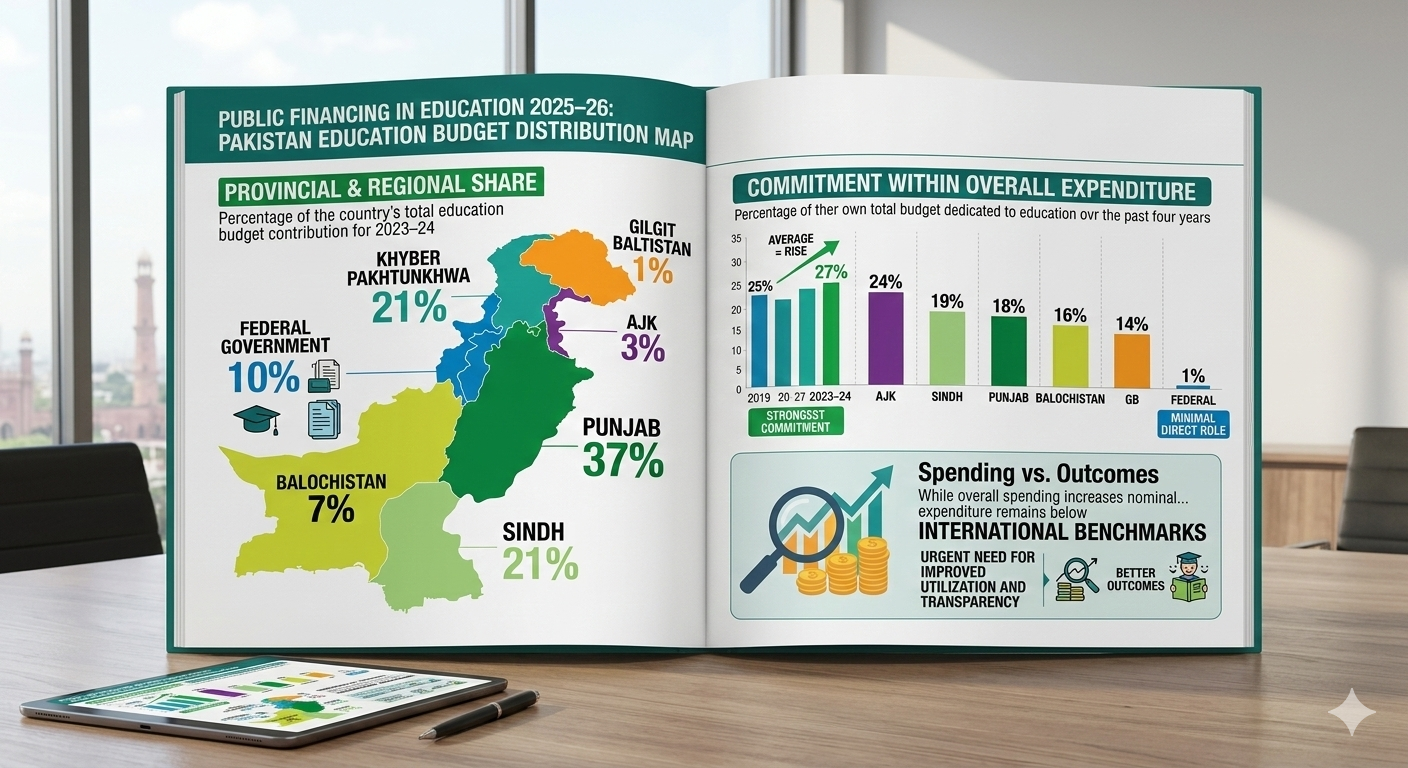
According to the findings for the 2023–24 fiscal year, Punjab remains the largest financial contributor, accounting for 37% of the total national education budget. This is followed by Sindh and Khyber Pakhtunkhwa (KP), which both contribute 21% each.
The federal government makes up 10% of total allocations, a share that is largely driven by its focus on higher education and administrative functions. Baluchistan accounts for 7% of the total, while Azad Jammu and Kashmir (AJK) and Gilgit Baltistan (GB) contribute 3% and 1% respectively.
While Punjab spends the most in total volume, the report highlights that Khyber Pakhtunkhwa has shown the strongest internal commitment to education. Over the last four years, KP has allocated an average of 25% of its total provincial budget to education, a figure that reached a peak of 27% in the 2023–24 cycle.
Azad Jammu and Kashmir also recorded a high priority level with an average of 24%. In sharp contrast, the Federal Government allocated only 1% of its total budget to education, reflecting its more limited role in direct school management since the 18th Amendment.
Despite these nominal increases in funding, the PIE report issues a sober warning. It notes that Pakistan’s overall education expenditure still falls well below international benchmarks. The report emphasizes that simply increasing numbers on a page is not enough. There is an urgent need for improved utilization and transparency to ensure that this funding actually translates into better outcomes for students. Officials noted that without better tracking of these funds, the country will continue to struggle with high rates of out-of-school children and low literacy levels.
About The Author