
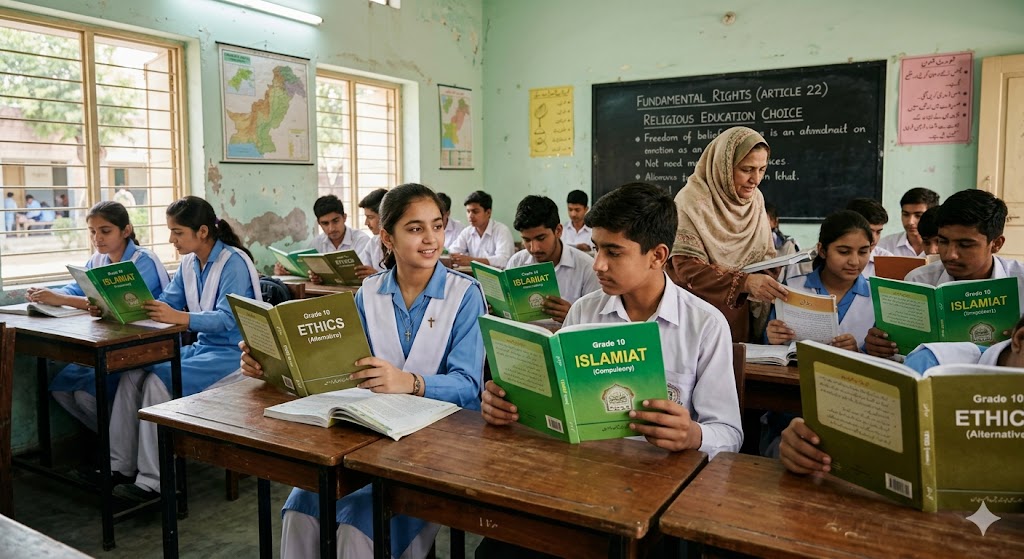
Education is supposed to be the great equalizer, a fundamental right that every state owes its children. Yet, in Pakistan, this right remains a distant dream for many, particularly within the Christian community. Currently, the school attendance rate for Christian children stands at a staggering and worrisome 4 percent. While poverty plays a massive role, a deeper, systemic issue is driving students away: the long-standing imposition of compulsory Islamic studies on non-Muslim students.
For over five decades, this practice has persisted in clear violation of Article 22 of the 1973 Constitution, which explicitly states that no student should be forced to receive religious instruction other than their own. For Christian, Hindu, and Sikh children, being forced to study a curriculum heavy in Arabic and Islamic theology often leads to poor marks and academic frustration.
This “knowledge gap” isn’t just about grades; it creates a cycle of discouragement that reinforces high dropout rates. Even in missionary schools, the requirement to hire Muslim teachers for these subjects remains a point of contention.
There was a flicker of hope in 2020 when the government announced an alternative curriculum covering seven minority religions. By January 2024, the Federal Ministry of Education officially approved a plan to make Islamic Studies optional for non-Muslims from grades 1 to 12. However, as we move into the 2026 academic year, that hope has turned into a bitter reality of “broken promises.”
Despite the high-level notifications, the promised textbooks for minority religions are nowhere to be found in the market. In Punjab, where the government provides free books, the demand lists sent to education officers didn’t even include the new subjects because no official instructions were issued. Consequently, this year too, minority students are being forced back into the same old curriculum.
The problem runs deeper than just one subject. Research from the Center for Social Justice (CSJ) reveals that Islamic content is heavily embedded in supposedly “neutral” subjects. For instance, Pakistan Studies textbooks contain up to 58% religious content, followed by Urdu at 38% and Social Studies at 33%. Geographically, the concentration of religious content is highest in textbooks from Khyber Pakhtunkhwa (39.6%) and Punjab (39.4%). This one-sided portrayal of history, often framing different religious groups in a victim-versus-oppressor narrative, limits the students’ ability to understand complex historical facts.
While the Catholic Church and various human rights commissions have spent years pushing for reform, the 36 minority members in our national and provincial assemblies have remained disappointingly silent.
The transformation that was supposed to begin years ago has been stalled by bureaucratic negligence and a lack of political will. In this environment, the burden of responsibility has shifted back to the community.
Christian educational institutions, churches, and social organizations must now step up to ensure these children are not only enrolled in school but also provided with “Bible Schools” and appropriate religious education that reflects their own faith.
Until the state aligns its actions with its own Constitution, the children of Pakistan’s minorities will continue to pay the price for a reform that exists only on paper.
About The Author