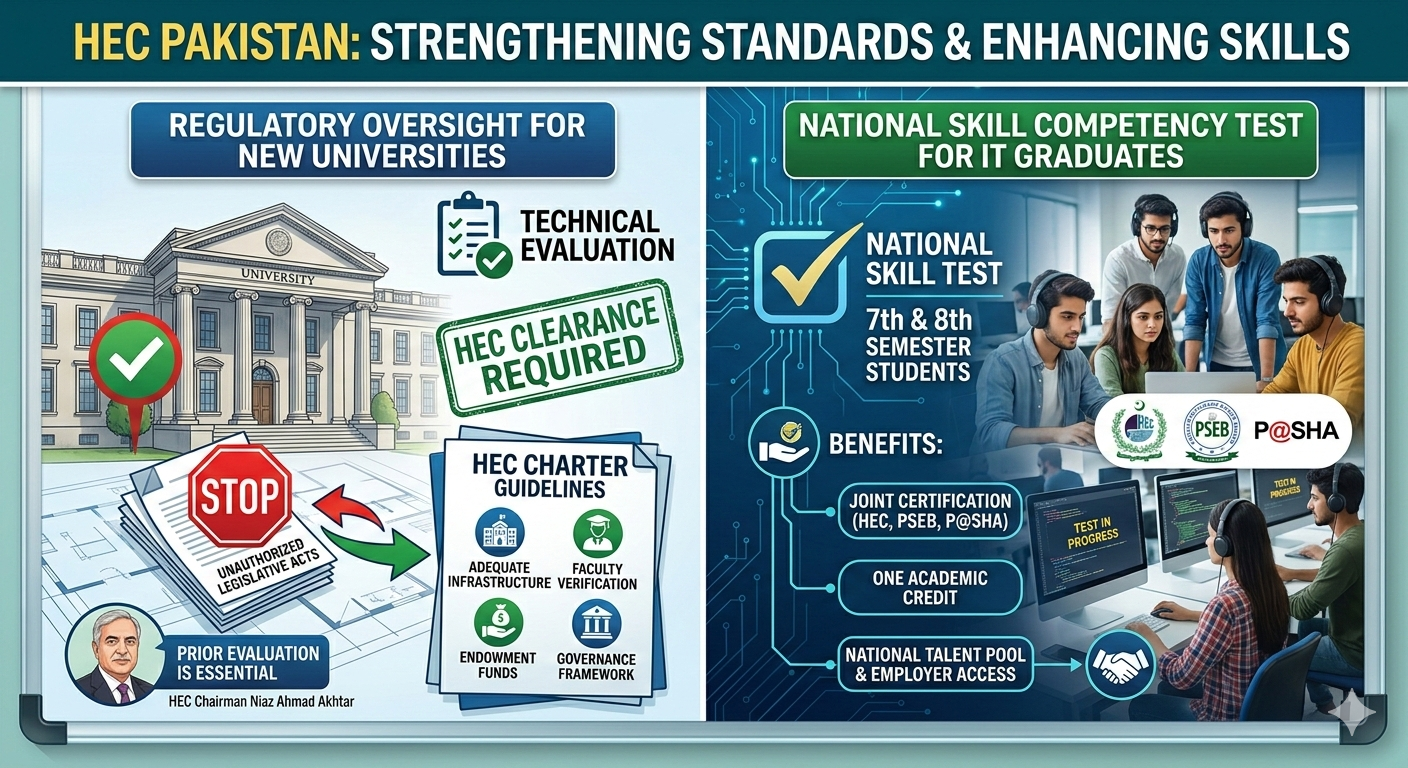
ISLAMABAD – The Higher Education Commission (HEC) has urged the National Assembly and the Senate of Pakistan not to consider legislative proposals for establishing new universities without first obtaining clearance from the commission. In a formal letter to the NA Speaker and Senate Chairman, HEC Chairman Niaz Ahmad Akhtar stressed that prior evaluation is essential to ensure alignment with national regulations, maintain academic standards, and avoid operational difficulties for institutions post-legislation.
Chairman Akhtar highlighted that some universities in the past were established through legislative acts without undergoing technical evaluation by the HEC. This has led to issues including faculty shortages, inadequate infrastructure, limited endowment funds, and governance challenges, which hampered the ability of these institutions to commence academic operations effectively.
“As the statutory regulator under the Higher Education Commission Ordinance 2002, HEC must verify that institutions meet minimum academic and quality standards before granting degree-awarding status,” Akhtar said. The commission also reminded lawmakers that federal cabinet-approved guidelines require comprehensive feasibility evaluations, infrastructure inspections, faculty verification, and a review of governance frameworks before granting a university charter.
Read More: https://informal.pk/hec-launches-national-skill-competency-test-for-it-graduates/
The directive underscores the HEC’s continued efforts to strengthen oversight of higher education and prevent the establishment of institutions that may fail to provide quality education due to inadequate preparation or resources.
In a separate announcement, the HEC also unveiled the launch of the National Skill Competency Test for IT graduates. Developed under directives from the Prime Minister, the test has been prepared in collaboration with the Ministry of Information Technology and Telecommunication, the Pakistan Software Export Board (PSEB), and the Pakistan Software Houses Association (P@SHA).
The test aims to evaluate the technical skills of IT students in their seventh and eighth semesters, covering programs such as computer science, software engineering, artificial intelligence, and data science. Participation is free, and successful candidates will receive joint certification from HEC, PSEB, and P@SHA, one academic credit from their universities, and inclusion in a national talent pool accessible to employers in Pakistan and abroad. The computer-based test is scheduled to be conducted nationwide on April 4 and 5, 2026.
With these steps, HEC continues to reinforce quality assurance in higher education while also bridging the gap between academic training and industry requirements, particularly in the technology sector.
About The Author