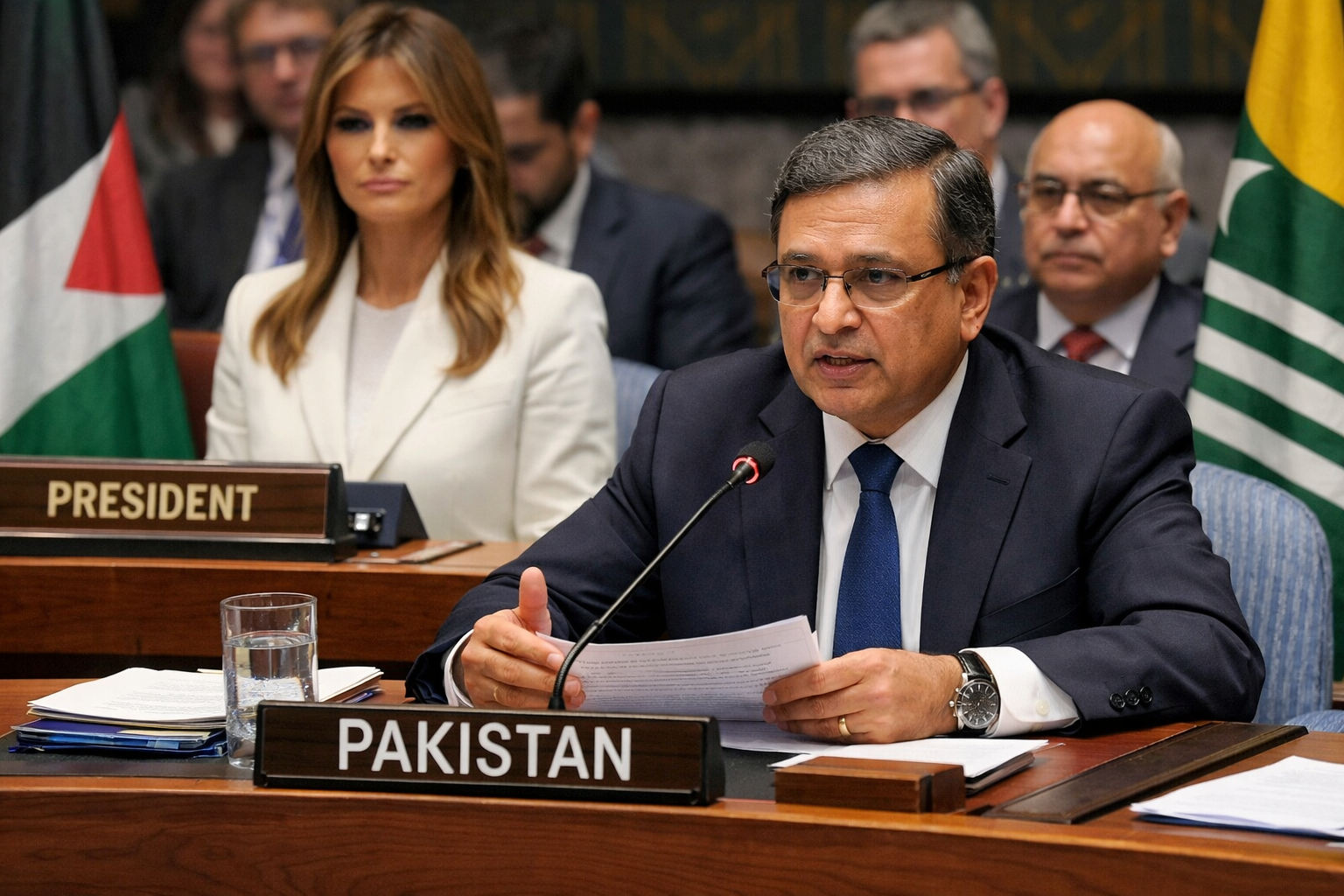
In a historic session of the United Nations Security Council, presided over by U.S. First Lady Melania Trump, Pakistan called for immediate action to protect children’s rights to education in conflict zones, emphasizing that lasting solutions depend on adherence to the UN Charter, international law, and the Council’s resolutions. The session, focusing on “Children, Technology and Education in Conflict,” also highlighted the critical situations in Palestine and Jammu and Kashmir.
Ambassador Asim Iftikhar Ahmad, Pakistan’s permanent representative to the UN, told the Council that millions of children worldwide are growing up surrounded by chaos instead of classrooms.
“Across conflict zones, including situations of foreign occupation, notably Palestine and Jammu and Kashmir, children are living amid rubble rather than calm and education,” he said. He outlined how schools have been destroyed or militarized, teachers displaced, and digital networks disrupted, pushing already fragile education systems to the brink of collapse.
The Pakistani envoy stressed that despite ongoing conflicts, the global community has a responsibility to ensure no child’s future is extinguished by circumstances beyond their control. He welcomed the U.S. First Lady’s initiative,
“Fostering the Future Together” aimed at creating a global coalition to enhance children’s well-being through education, technology, and innovation. “Pakistan is pleased to join this initiative,” Ambassador Ahmad said, adding that safeguarding education is not merely about technology, but about protecting human dignity and securing the future of an entire generation.
He warned that the systematic erosion of education in conflict zones compounds trauma and perpetuates cycles of violence. “When education is interrupted over extended periods, it creates consequences that extend far beyond the immediate conflict,” he said. Education, he emphasized, stabilizes communities, prevents exploitation and radicalization, and fosters resilience, critical thinking, and hope.
Highlighting the role of technology, Ambassador Ahmad noted that digital platforms and mobile learning tools can sustain learning for displaced or isolated children. Remote instruction and emerging technologies, including artificial intelligence, can provide personalized and inclusive education.
However, he urged vigilance, warning that unregulated digital access could expose children to exploitation, disinformation, and abuse. He called for investment in resilient infrastructure, affordable connectivity, and access to devices, prioritizing girls and children with disabilities, and integrating child protection in all digital initiatives.
The session took place amid escalating tensions in the Middle East, with U.S.-Israeli air strikes against Iran and widespread calls for restraint. Presiding over the debate, Mrs. Trump said the United States “stands with all of the children throughout the world,” marking the first time a First Lady has chaired a Security Council meeting.
UN Under-Secretary-General Rosemary DiCarlo described the debate as “a moment of exceptional relevance,” noting that conflicts are at their highest since World War II and civilians, particularly children, are among the hardest hit. She cited that globally, 473 million children—one in five—live in or flee conflict zones, with recent school closures in Israel, the UAE, Qatar, Bahrain, and Oman underscoring the urgent challenge.
Ambassador Ahmad concluded by urging collective action, calling technology “a shield and a bridge” to ensure children’s right to safety, learning, and development, and ultimately, to foster resilience, dignity, and lasting peace.
About The Author