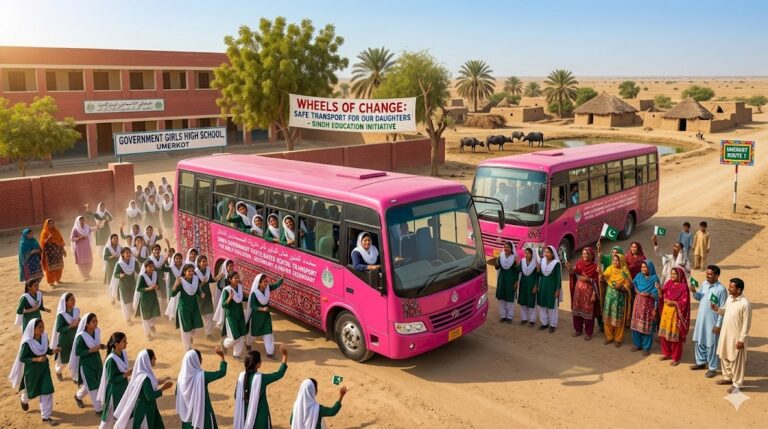

Pakistan has witnessed a landmark shift in girls’ education, according to the newly released Girls’ Education Statistics and Trends Report 2023-24 by the Federal Ministry of Education and Professional Training. Launched by Federal Minister Khalid Maqbool Siddiqui at the Pakistan Institute of Education (PIE), the report highlights remarkable progress in school completion rates, infrastructure, and academic performance, even as systemic challenges continue to persist.
The report reveals that the primary school completion rate for girls has surged from 75% to 89%, reflecting a substantial return on investments in educational infrastructure. Across the country, 96% of schools now operate from permanent buildings, 92% have functional toilets, and 82% provide access to clean drinking water. Despite these gains, malnutrition remains a critical concern, affecting students’ physical growth and posing a key challenge for policymakers.
Data from the National Achievement Test (NAT) 2023 highlights that female students are outperforming their male counterparts across key subjects. In particular, girls scored higher on average in English, Urdu/Sindhi, and Mathematics. In Grade 8, girls demonstrated clear superiority in Science and Math, underscoring their academic potential.
However, the report also flags a significant socio-economic gap. While women have achieved near-parity in university enrollment, their participation in the workforce remains low at just 24%. Minister Siddiqui described this as a “waste of human capital” and emphasized that transitioning educated women into the professional workforce is a critical challenge for the nation.
The report also paints a broader picture of systemic hurdles in Pakistan’s education sector. Around 26.2 million children remain out of school, including 13.4 million girls. Furthermore, the education budget’s share has declined from 13% to 11%, with 94% of funds consumed by salaries, leaving minimal resources for development or maintenance projects.
Technological integration is limited, with only 19% of schools equipped with digital tools, and just 23% providing ramps for disabled students. Specialized assistive learning materials remain largely unavailable.
Speaking at the launch, Minister Siddiqui stressed that accurate data must serve as the foundation for future policies. “With 140 million youth, the state must choose whether to see this demographic as a burden or a strategic asset,” he said, emphasizing that every girl who attains a degree or skill has a fundamental right to pursue professional opportunities.
Minister of State Wajiha Qamar added that the ministry is preparing a targeted Action Plan to address gaps identified in the report, focusing on teacher training, digital integration, and improving facilities.
Read More: https://informal.pk/cybersecurity-training-made-mandatory-for-all-private-school-staff-in-islamabad/
The Girls’ Education Statistics and Trends Report 2023-24 concludes that while Pakistani girls have demonstrated extraordinary academic potential, substantial investment in development budgets, modernized facilities, and equitable access remains essential to fully realize this promise.
The report serves as both a celebration of progress and a call to action for policymakers, educators, and society to bridge the remaining gaps, ensuring that the future of girls’ education translates into meaningful professional and social empowerment.
About The Author