LAHORE – In a sweeping reform aimed at dismantling a long-standing culture of favoritism and grade inflation, the Punjab government has officially stripped on-site examiners of their power to award full marks during board practical examinations.
For years, the practical component of matriculation and intermediate exams has been shadowed by allegations of systemic bribery and “recommendation” culture. Under the previous system, examiners present at the centers held near-total control over the 30 marks allotted for practicals, which frequently resulted in perfect scores for students with the right social or political connections.
That era of unchecked discretion ends today as a new centralized marking policy takes effect across all educational boards in the province. Under the revised framework, the 30 marks allocated for practical examinations are being split into two distinct categories to ensure transparency.
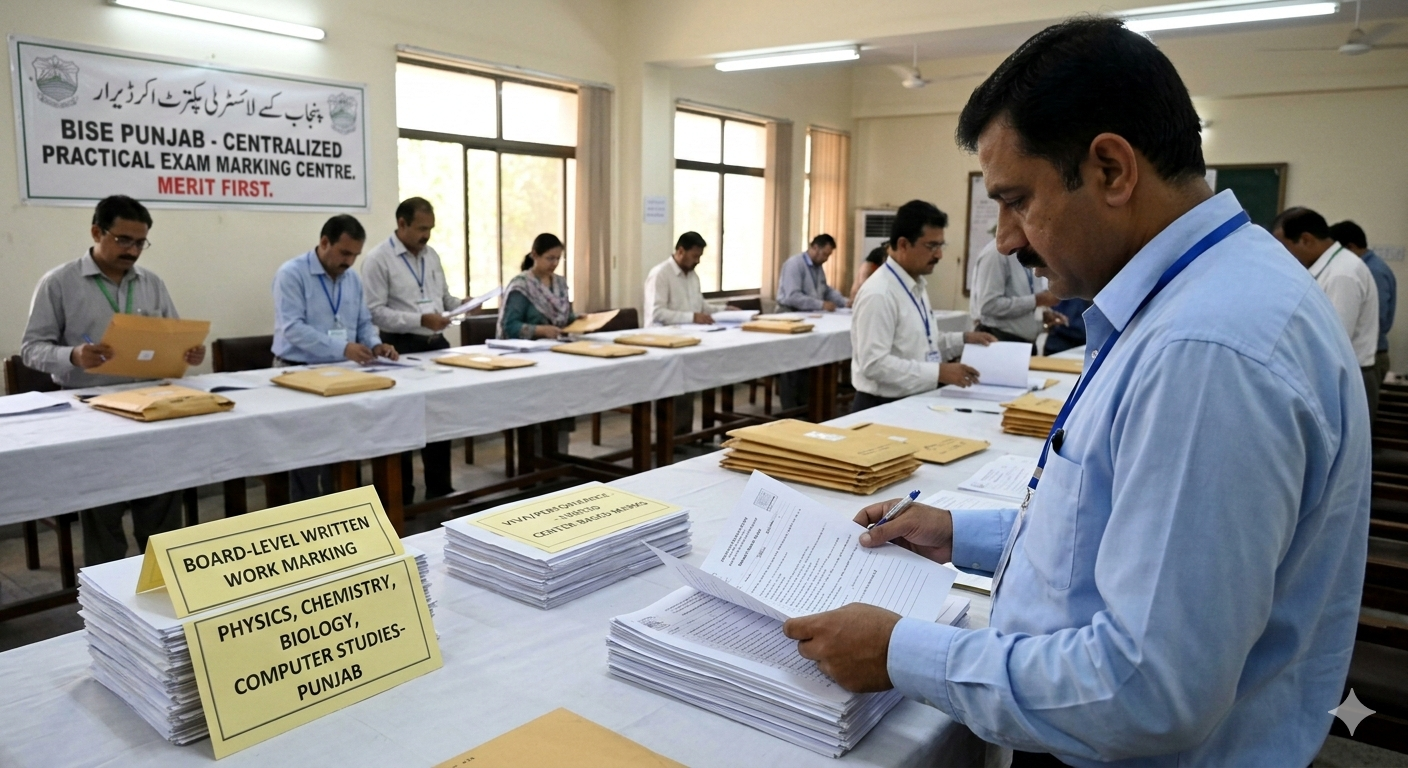
The written portion of the practical exam, the answer sheets where students document their experiments and findings, will no longer be graded on the spot. Instead, these sheets will be collected, sealed, and sent directly to the respective education boards for marking by a centralized team of anonymous evaluators.
The authority of the examiners physically present at the testing centers has been significantly curtailed. Their role is now restricted to awarding limited marks for the viva voce and the student’s physical performance during the experiment. This shift effectively removes the ability of a single individual at a testing site to influence a student’s final grade through preferential marking.
Muzammil Mahmood, Chairman of the Task Force Committee for Boards, stated that the change is designed to ensure that practical exams are more than just a “formal” or “oral” exercise. He emphasized that marks will now be awarded strictly on merit, reflecting a student’s actual scientific capability rather than their influence.
The new policy applies immediately to practical examinations in Physics, Chemistry, Biology, and Computer Studies. By moving the evaluation of written work to a central board, the government hopes to level the playing field for high-achieving students who previously lacked the “recommendations” necessary to compete with their peers.
While the move is a win for academic integrity, it remains to be seen how the boards will handle the logistical challenge of grading thousands of additional scripts with the same rigor as the primary theory exams.
About The Author