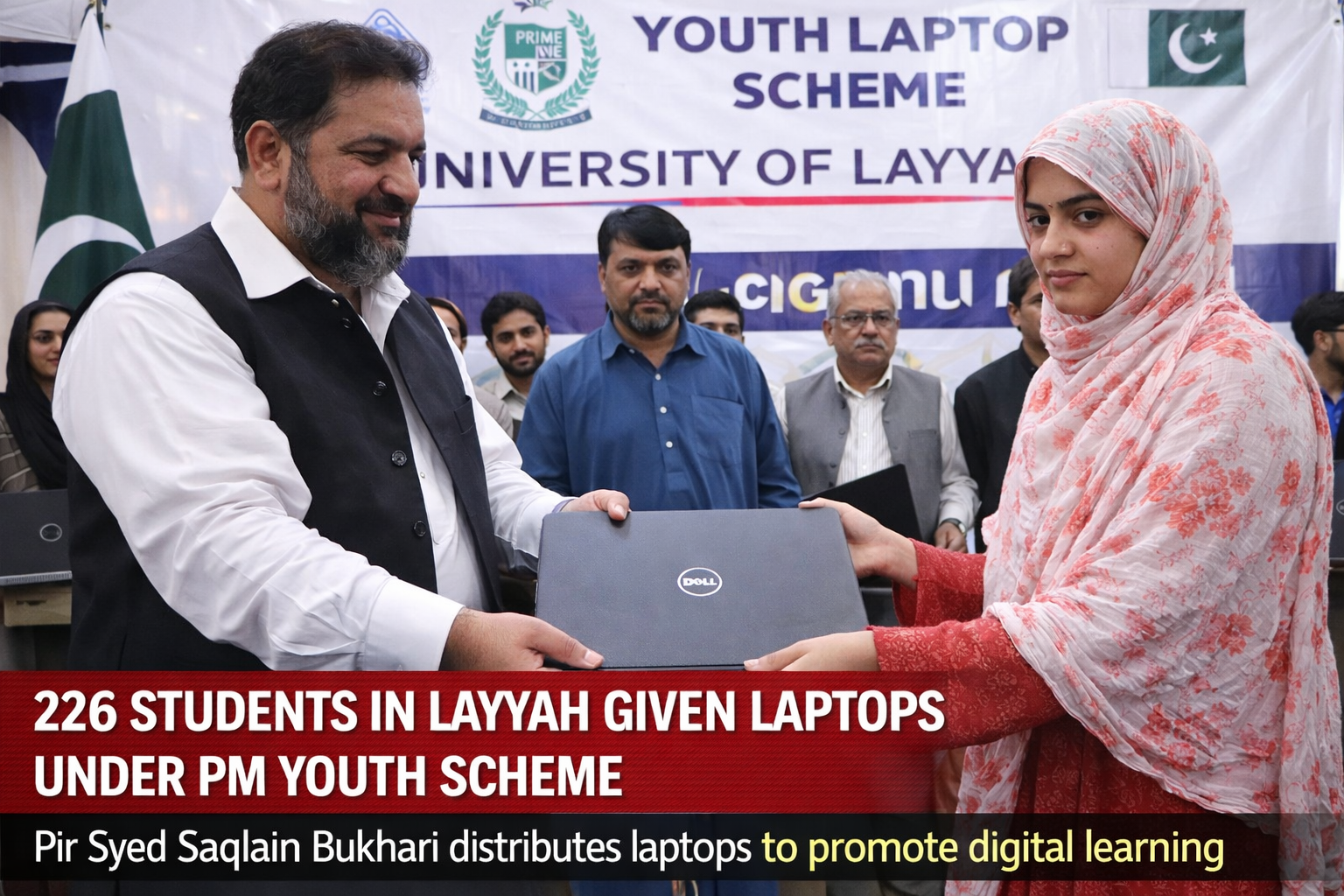
The air at the University of Layyah was thick with excitement on Thursday as 226 students lined up to receive laptops under the Prime Minister’s Youth Laptop Scheme, a move aimed at equipping the younger generation with the tools of the digital era.
The ceremony, held in the university’s main auditorium, drew political and administrative figures alongside faculty and students. Former MNA Pir Syed Saqlain Shah Bukhari, the chief guest, handed out the laptops, marking a symbolic yet tangible step toward empowering youth in one of Pakistan’s growing educational hubs.
Speaking to the audience, Pir Saqlain Bukhari praised the initiative, highlighting Prime Minister Shehbaz Sharif’s commitment to youth development. “Reviving the Youth Laptop Scheme is not just about providing machines; it’s about opening doors to knowledge and opportunity,” he said. “In today’s world, access to technology is access to progress, and our young people deserve both.”
He stressed that such programs could bridge gaps in digital literacy, particularly in regions like Layyah, where many students face challenges in acquiring personal computing devices. “A laptop in the hands of a student is more than a gadget. It is a gateway to research, innovation, and the global community,” Bukhari remarked.
University Vice Chancellor Prof Dr Muhammad Zubair Abubakar assured the gathering that the distribution process had been conducted transparently and strictly on merit. “Every laptop has reached a deserving student. The selection was based on clear criteria, and fairness was our top priority,” he said.
Dr Zubair also emphasized the growing importance of digital skills in higher education. “From accessing online journals to participating in virtual classrooms and conducting research, students increasingly depend on technology. Providing them with personal laptops ensures they can compete academically on a level playing field.”
The excitement among students was palpable. A final-year science student, visibly thrilled, said, “For the first time, I can complete my research project at home without waiting for hours in the computer lab. This laptop will change the way I study.”
Another student from the social sciences department shared a similar sentiment. “Many of us come from families where buying a laptop is difficult. This initiative shows that the government is thinking about students in smaller cities too,” he said.
Observers noted that such initiatives do more than just provide devices they signal a commitment to bridging the digital divide. While infrastructure, faculty, and curriculum reforms are critical for improving higher education, immediate interventions like this have a visible and meaningful impact on students’ daily learning experiences.
The Prime Minister’s Youth Laptop Scheme, first introduced several years ago, has been revived under Shehbaz Sharif’s government to expand digital access and inclusion. By targeting students at both public and private universities, the program aims to ensure that young Pakistanis are prepared for a world increasingly shaped by technology, data, and online learning platforms.
For the University of Layyah, Thursday was a moment to celebrate academic ambition and technological empowerment. For the students who received their laptops, it was a first step toward embracing a digital future filled with possibilities.
About The Author