
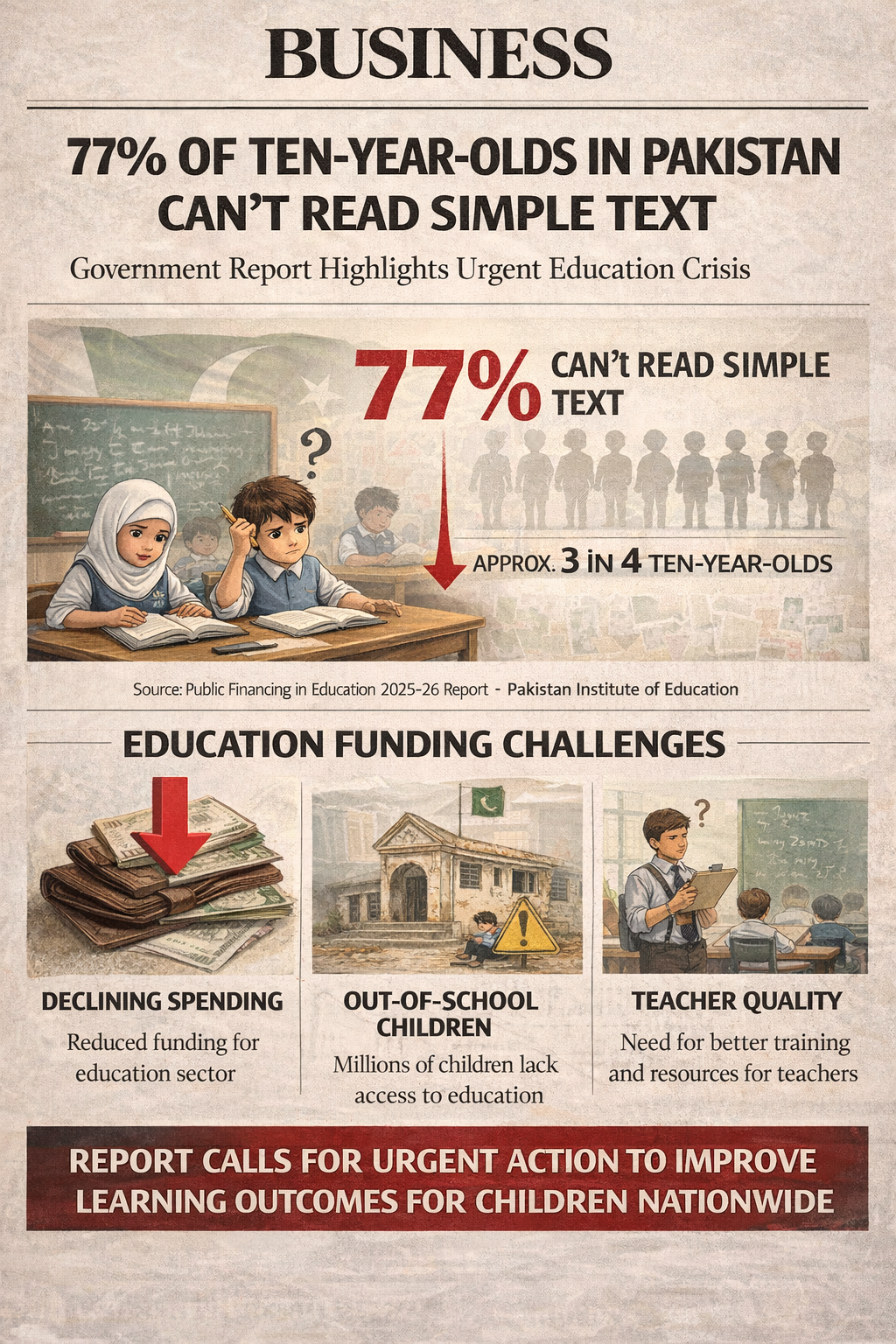
ISLAMABAD – A recently released government report has raised alarm over Pakistan’s education sector, revealing that 77 percent of ten-year-olds in the country are unable to read and comprehend a simple text. The findings underscore serious challenges in both learning outcomes and education funding, highlighting the urgent need for reforms.
The report, titled “Public Financing in Education 2025-26,” was issued by the Pakistan Institute of Education (PIE), a body operating under the Ministry of Federal Education and Professional Training. The 171-page document was officially released in Islamabad on Thursday and provides a detailed analysis of the current state of education in Pakistan.
According to the report, persistent underfunding, declining spending, and weak alignment between financial resources and educational outcomes remain major obstacles. It points to an alarming number of out-of-school children and emphasizes the need to improve teacher quality, access to learning materials, and assessment systems.
Officials involved in the report highlighted that the declining trend in education spending reflects a weakening position of education within the national fiscal framework. The report notes that insufficient allocation of funds across the education sector has adversely affected public schools, special education programs, and provincial education initiatives.
“The report clearly shows that financial and structural weaknesses in the system are directly impacting student learning outcomes,” said an education ministry official familiar with the findings. “It is crucial to align budget priorities with improvements in teacher training, learning materials, and evaluation methods to ensure every child has the opportunity to learn effectively.”
Read More: https://informal.pk/education-amidst-the-rubble-pakistans-plea-at-the-un-security-council/
The report also draws attention to the role of provincial foundations, which are responsible for implementing education policies and improving outcomes at the local level. However, it notes that inadequate support and monitoring have limited their impact.
Education experts stress that addressing these challenges is essential not only for individual student success but also for the country’s long-term social and economic development. They urge policymakers to increase funding, strengthen monitoring systems, and adopt evidence-based interventions that target both teachers and students.
The release of this report comes amid growing concern over Pakistan’s literacy rates and the quality of public education. As the government seeks to meet national and international education targets, the findings serve as a stark reminder of the work that remains to ensure children can read, comprehend, and thrive in the learning environment.
About The Author