By all official accounts, Pakistan’s progress in girls’ education appears remarkable. The Statistics and Trends Report 2023–24 on Girls’ Education, prepared by the Pakistan Institute of Education (PIE) in collaboration with the Malala Fund and the Pakistan Alliance for Girls’ Education (PAGE), paints a promising picture: primary completion rates have risen, girls are outperforming boys in national assessments, and school infrastructure has improved.
Major newspapers quickly praised these gains. Editorials hailed the country’s apparent success, celebrating rising numbers as a national victory. Yet, as with any set of statistics, numbers can both illuminate and obscure. A closer reading of the report, its data, and its public framing reveals a more complex reality.
The Numbers That Tell a Story—and Those They Hide
Primary completion for girls has risen from 75% to 89% over the past decade—a fourteen-point increase translating into millions of additional girls completing primary school. These gains are real and deserve recognition. Yet, the discourse around progress has sometimes relied on outdated or inflated figures. At the launch of the report in Islamabad, speakers cited 26.2 million out-of-school children, including 13.4 million girls.
Official statistics, however, place the current number at 25.1 million children, with 12.18 million girls. The discrepancy highlights a subtle but significant challenge: in education, numbers shape perception, funding, and reform priorities. Accuracy is not merely technical; it affects policy credibility.
Read More: https://informal.pk/punjab-shuts-educational-institutions-amid-global-oil-crisis-concerns/
National Averages Mask Regional Inequalities
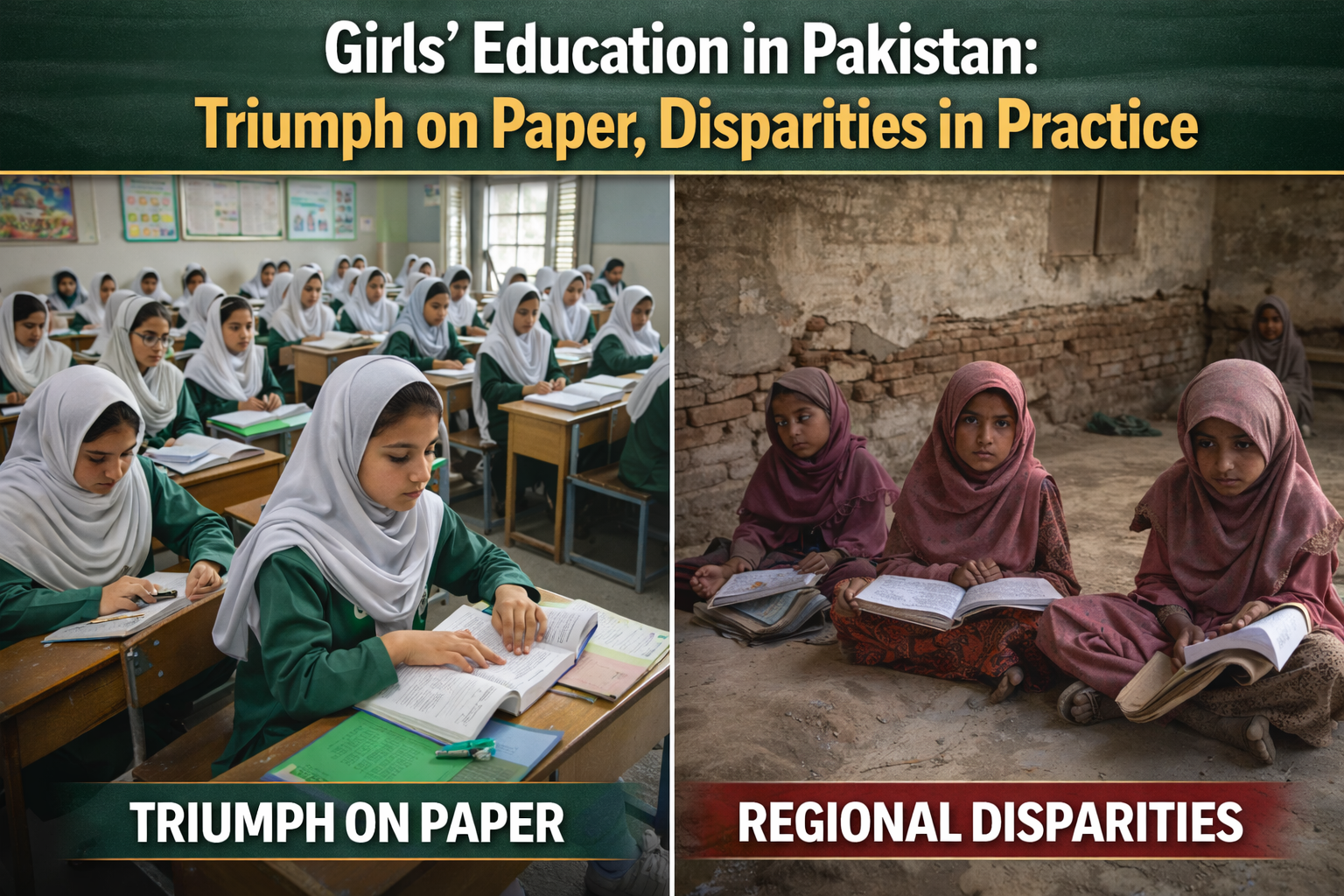
On the surface, Pakistan’s out-of-school rate shows gender parity: 35% for both boys and girls. But this national average conceals stark provincial differences. Punjab, the most populous province, reports a girls’ out-of-school rate of 22% versus 32% for boys—a “reverse gap” that skews national averages downward.
Meanwhile, provinces like Balochistan (73%) and Sindh (49%) reveal far more severe exclusion for girls. Statistical parity at the national level masks persistent inequities across regions, making the headline numbers less meaningful on the ground.
Investment and Quality Remain Weak Points
Another concern lies in public expenditure. Pakistan spends only about 1.5% of GDP on education, far below the 4–6% benchmark aligned with Sustainable Development Goal 4. Education’s share of the national budget has declined from 13% to 11%, and almost 90% of this allocation is consumed by salaries. While enrolment numbers grow, investment in learning quality remains insufficient, raising questions about whether the system is producing meaningful educational outcomes or simply counting attendance.
The Challenge Ahead
The report highlights substantial gains, but triumph on paper does not equal systemic equity. Pakistan’s education landscape is constitutionally devolved: provinces bear the primary responsibility for schooling. Ignoring provincial disparities, as the report’s public narrative often does, risks creating a perception of nationwide success while leaving millions of children—especially girls in underperforming regions—behind.
About The Author