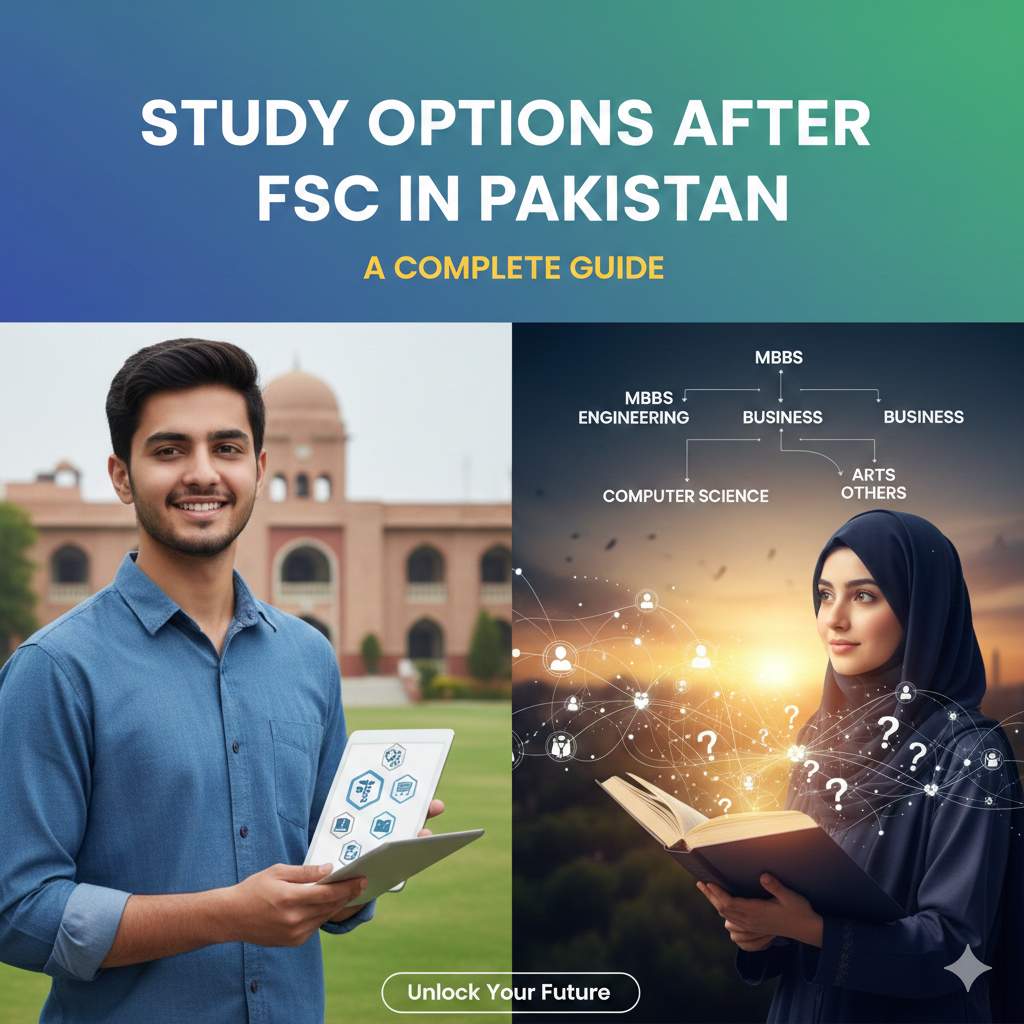
Study Options After FSC in Pakistan A Complete Guide
Completing FSC (Faculty of Science) is a crucial step for students in Pakistan, opening doors to higher education and career opportunities. Many students feel uncertain about what to study next, especially when there are multiple options in both sciences and arts. Understanding available courses, career prospects, and admission requirements can help make a well-informed decision. This guide will explain the main study pathways after FSC in Pakistan, helping students choose the right direction for their future.
1. Medical Field: For Pre-Medical Students
Students who completed FSC with Pre-Medical subjects (Biology, Chemistry, Physics) usually aim for careers in healthcare. The medical field in Pakistan offers numerous options:
- MBBS (Bachelor of Medicine and Bachelor of Surgery): The most popular choice for Pre-Medical students, MBBS leads to becoming a licensed doctor. It usually takes 5 years to complete, followed by a one-year internship. Admission requires passing the MDCAT (Medical and Dental College Admission Test).
- BDS (Bachelor of Dental Surgery): For students interested in dentistry. Like MBBS, it’s a 5-year program plus a 1-year internship.
- Pharmacy (Pharm-D): A 5-year program focusing on medicines, their preparation, and usage. Graduates can work in hospitals, pharmaceutical companies, or research labs.
- Allied Health Sciences: Includes programs like Medical Laboratory Technology, Physiotherapy, Optometry, and Radiology. These courses are shorter than MBBS and still lead to professional careers in healthcare.
Medical careers require dedication and hard work, but they offer stable jobs and respect in society.
2. Engineering: For Pre-Engineering Students
Pre-Engineering students (Physics, Chemistry, Mathematics) often pursue engineering degrees. Engineering is a versatile field with many branches:
- Civil Engineering: Involves designing and constructing buildings, roads, bridges, and other infrastructure.
- Mechanical Engineering: Focuses on machines, engines, and manufacturing systems.
- Electrical Engineering: Deals with electrical systems, power generation, and electronics.
- Computer Engineering: Combines computer science and electronics for software and hardware development.
- Petroleum and Chemical Engineering: Specializations in energy, chemicals, and industrial processes.
Engineering programs are usually 4 years long. Top universities in Pakistan, such as NUST, UET, and PIEAS, offer excellent programs. Engineers often have high employment opportunities locally and internationally.
3. Computer Science and IT
Students from both Pre-Medical and Pre-Engineering backgrounds can enter computer science and IT fields, provided they meet the mathematics requirements. Popular options include:
- BS Computer Science: Focuses on software development, programming, artificial intelligence, and data science.
- BS Information Technology: Emphasizes networking, cybersecurity, and system management.
- Software Engineering: Combines programming with engineering principles for large software systems.
The IT sector in Pakistan is rapidly growing, with opportunities in multinational companies, startups, and freelancing. Students skilled in coding, web development, and app creation are in high demand.
4. Business and Commerce
FSC students interested in management, finance, or accounting can shift to business studies. Courses include:
- BBA (Bachelor of Business Administration): Offers knowledge in management, marketing, and entrepreneurship.
- Accounting and Finance: Leads to roles like accountant, financial analyst, or auditor.
- Economics: Focuses on economic policies, business trends, and financial markets.
These courses usually last 4 years. Many students also pursue professional certifications like ACCA, CFA, or CA along with a degree to increase career prospects.
5. Arts and Social Sciences
Some students discover their interests in arts, humanities, or social sciences after FSC. Popular options include:
- Psychology: Study of human behavior, emotions, and mental health.
- Sociology: Focuses on society, communities, and social issues.
- Political Science and International Relations: Careers in government, NGOs, or diplomacy.
- Education: Prepares students for teaching and academic roles.
These fields may not require strong science skills but offer meaningful and diverse career paths.
6. Professional and Technical Courses
Apart from traditional degrees, FSC students can also consider professional and technical courses. These programs are often shorter, focused, and skill-oriented:
- Diploma in Engineering Technology: Short-term programs in mechanical, electrical, or civil fields.
- Graphic Designing, Animation, and Multimedia: For creative students interested in digital media.
- Hotel Management and Tourism: Growing industries in Pakistan with practical training and jobs.
- Aviation and Pilot Training: Specialized courses for careers in airlines and aviation management.
Professional courses help students gain skills quickly and enter the workforce sooner.
7. Study Abroad Options
Many students after FSC also consider studying abroad. Popular destinations include the USA, UK, Canada, and Australia. Students can pursue:
- Medicine, Engineering, or Computer Science degrees in internationally recognized universities.
- Short courses, certifications, or diplomas for specialized skills.
Studying abroad requires careful planning, including IELTS/TOEFL, SAT, or other entrance exams, as well as visa preparation and financial planning.
8. Factors to Consider Before Choosing a Field
Choosing the right course after FSC is a critical decision. Students should consider:
- Interest and Passion: A field aligned with personal interest leads to better learning and career satisfaction.
- Career Opportunities: Some fields have higher demand in Pakistan and abroad, which can influence income and growth.
- Skills and Strengths: For example, strong mathematics skills suit engineering, while creativity suits design fields.
- Duration and Cost: Professional degrees like MBBS are long and expensive, while technical diplomas are shorter and affordable.
- Future Trends: IT, data science, renewable energy, and healthcare are growing sectors with long-term opportunities.
9. Preparing for Admission
Most universities in Pakistan have specific entry requirements. Pre-Medical students must take MDCAT or equivalent tests, while engineering aspirants often take ECAT. Other programs may require SAT, GAT, or university-specific tests. Good academic performance in FSC, along with preparation for these tests, is essential for admission to top institutions.
Conclusion
After FSC, Pakistani students have a wide range of study options depending on their subjects, interests, and career goals. Medical, engineering, computer science, business, arts, and professional courses all offer unique opportunities. The key is to research, evaluate personal strengths, and choose a path that aligns with long-term aspirations. Proper guidance, career counseling, and preparation can help students make informed decisions, ensuring a successful academic and professional journey.
Choosing the right course after FSC is the first step toward a rewarding career and a bright future in Pakistan or abroad.
Also Read: https://informal.pk/best-fields-to-study-in-pakistan-a-practical-guide-for-students/
About The Author