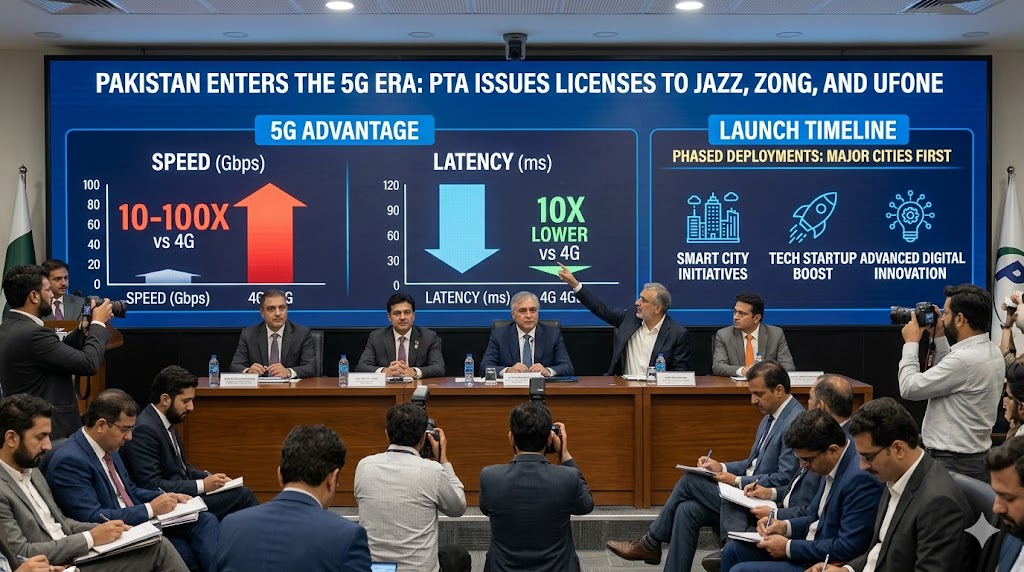
ISLAMABAD – In a move that market analysts are calling a “digital watershed moment,” the Pakistan Telecommunication Authority (PTA) has officially issued 5G licenses to the country’s three major mobile operators:
Jazz, Zong, and the newly consolidated Ufone-Telenor entity. The announcement, made early Wednesday, effectively fires the starting gun on a high-stakes race to bring next-generation connectivity to over 200 million Pakistanis.
The decision comes after months of rigorous technical evaluations and regulatory back-and-forth. According to the PTA, all three heavyweights have successfully met the stringent financial and infrastructure requirements laid out by the government.
This development isn’t just about faster downloads; it represents a fundamental shift in the country’s technological backbone, moving Pakistan closer to regional competitors like India and the UAE, who have already made significant strides in 5G deployment.
What This Means for the Average User
For the millions of Pakistanis currently frustrated by fluctuating 4G speeds and late-night buffering, the promise of 5G is transformative.
Beyond just “seamless streaming,” the new technology offers ultra-low latency—the delay between sending and receiving data. This is the “secret sauce” required for everything from lag-free competitive gaming to real-time remote surgery and, eventually, autonomous vehicles on the streets of Lahore and Islamabad.
“We aren’t just looking at a better mobile experience; we are looking at the foundation for smart cities,” noted a senior official at the PTA. “From managing traffic flow via AI-linked sensors to providing high-speed internet in areas where laying fiber-optic cables was previously impossible, 5G fills the gap.”
Read More: https://informal.pk/ptcl-telenor-merger-clears-final-regulatory-hurdle-a-new-telecom-giant-emerges/
Fueling the Startup Ecosystem
Economic experts are particularly bullish on what this means for Pakistan’s burgeoning tech sector. In a year where trade deficits and regional volatility have dominated the headlines, the 5G rollout offers a rare bright spot for foreign investment. Tech startups in Karachi and the National Incubation Centers are expected to be the primary beneficiaries, as the increased bandwidth allows for the development of complex data-heavy applications that were previously restricted by 4G limitations.
However, the rollout won’t happen overnight. The PTA confirmed that the deployment will follow a “phased approach.” Residents in major urban centers—specifically Islamabad, Karachi, Lahore, and Faisalabad—are expected to see the first 5G signals on their devices within the coming months. Rural areas will likely follow as operators begin the massive task of upgrading their existing 26,000-plus tower network with 5G-enabled hardware.
The Road Ahead: Challenges and Costs
While the mood is celebratory, industry insiders warn that the road to nationwide coverage is paved with challenges. The massive investment required for 5G hardware, coupled with the ongoing volatility in the exchange rate, means that operators will be under pressure to keep services affordable while recouping their costs.
Despite these hurdles, the general sentiment among the public and the tech community is one of relief. As the licenses are signed and the technical teams begin their work, Pakistan has officially signaled that it is no longer content to wait on the sidelines of the global digital revolution.
About The Author