
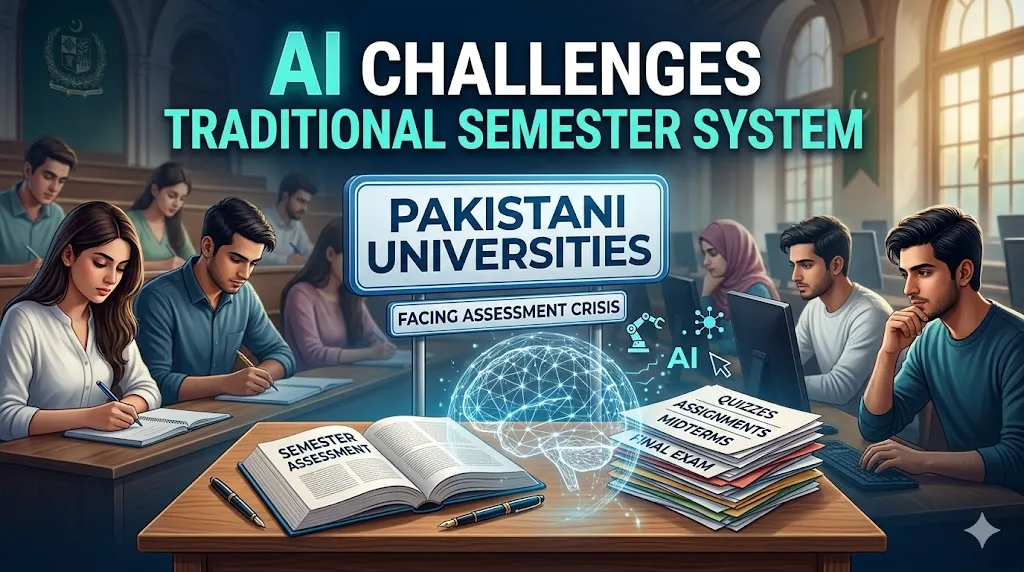
Pakistan’s higher education system is facing renewed scrutiny as long-standing weaknesses in the semester-based assessment model become more visible in the age of artificial intelligence. Introduced to modernize learning and align with international standards, the system is now being tested by rapid technological change and persistent gaps in implementation.
The semester system, adopted under guidelines issued by the Higher Education Commission (HEC), was designed to shift academic evaluation away from a single final exam toward continuous assessment. The framework encourages a combination of quizzes, assignments, presentations, midterms, lab work, and final exams to promote deeper understanding and practical skills rather than rote memorization.
According to HEC, the goal was to establish a credit-based system that reflects student learning outcomes in a way that is transparent and internationally recognized. The model was also expected to improve fairness by incorporating multiple forms of evaluation throughout the academic term.
However, more than a decade later, experts and observers say the system has yet to fully deliver on its promise. Many universities continue to rely heavily on memorization-based questions, with limited emphasis on critical thinking or analytical problem-solving. In some cases, assessments are not rigorously reviewed, raising concerns about consistency and academic integrity.
A 2022 survey reported by the Associated Press of Pakistan found that while most institutions follow the general structure of semester-based evaluation, many lack external moderation mechanisms. Without independent review, grading practices can vary significantly, undermining the credibility of academic outcomes.
These issues have been further complicated by the rapid rise of generative artificial intelligence tools such as ChatGPT and Gemini. Students increasingly use these technologies to complete assignments, generate reports, and even draft degree theses. While these tools can support learning when used responsibly, their misuse has sparked alarm within academic circles.
A recent parliamentary briefing highlighted growing concerns about declining originality and critical thinking among students, as AI-generated content becomes easier to produce and harder to detect. In response, the HEC has strengthened its anti-plagiarism measures by deploying advanced detection systems like Turnitin to identify copied or AI-assisted work.
Despite these efforts, experts warn that detection tools alone may not be enough. If assessment methods do not require genuine understanding or in-person demonstration of knowledge, they remain vulnerable to manipulation in a digital environment.
International universities are already adapting to this challenge. Institutions such as the University of Sydney are experimenting with hybrid approaches to assessment, including controlled environments where digital tools are restricted, alongside open assignments where AI is permitted under supervision. The aim is to strike a balance between maintaining academic integrity and preparing students for a future where AI is widely integrated into professional life.
For Pakistan, the situation presents both a challenge and an opportunity. Strengthening assessment practices, introducing external quality checks, and redesigning exam formats to test higher-order thinking skills could help restore confidence in the system.
As technology continues to evolve, so too must academic policies. The effectiveness of Pakistan’s higher education system will increasingly depend on its ability to ensure that degrees reflect real learning—not just the ability to navigate tools that can produce answers in seconds.
About The Author