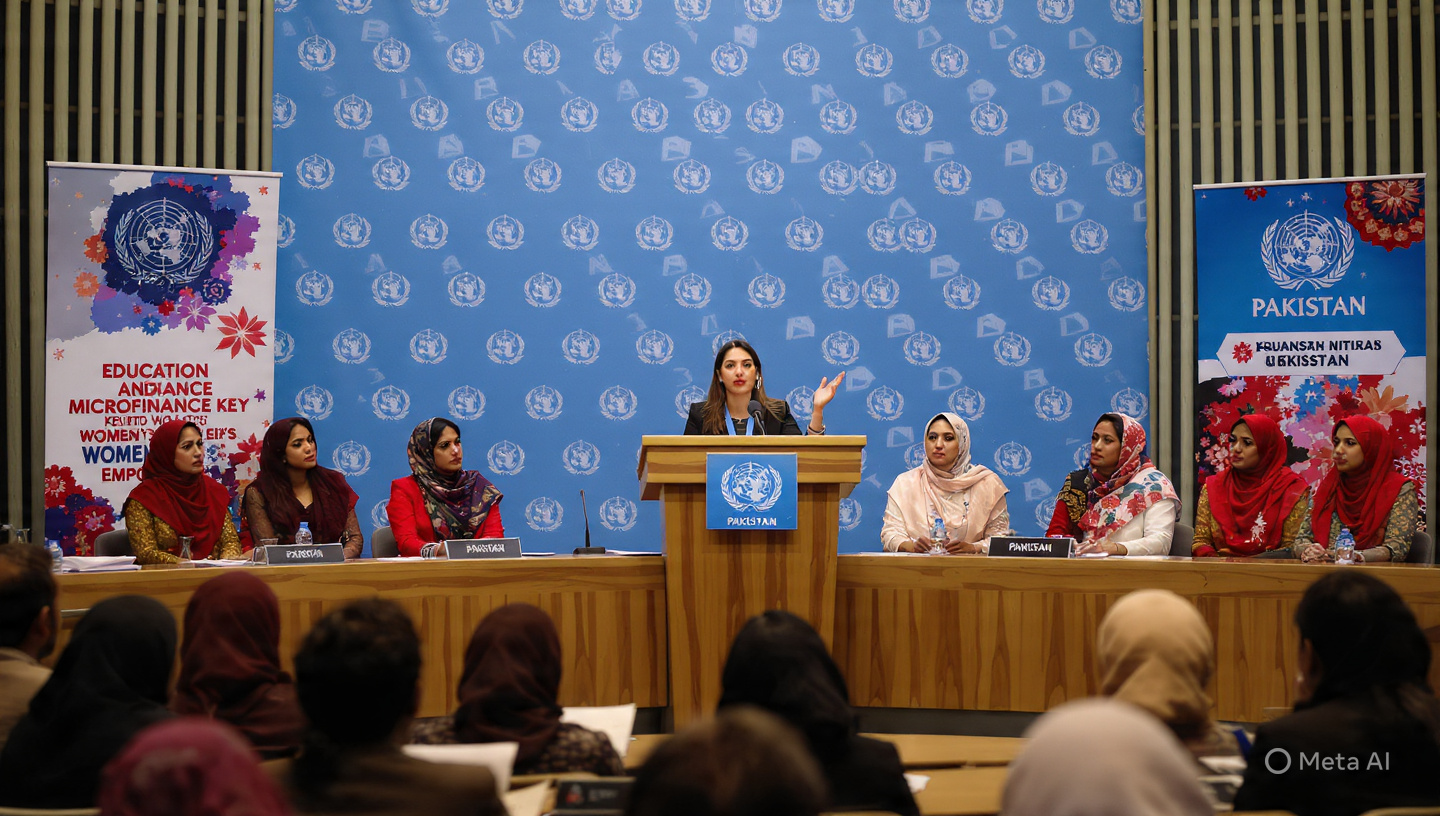
An event held on the sidelines of the 70th Session of the UN Commission on the Status of Women highlighted the transformative power of education and economic opportunity in advancing women’s empowerment in Pakistan, with speakers emphasizing that protecting children’s right to learn and dream must remain a global priority regardless of political conflict or instability.
The side-event took place at United Nations headquarters in New York and was organized by the Permanent Mission of Pakistan to the United Nations in collaboration with the Muslim American Leadership Alliance (MALA), a U.S.-based non-profit organization.
Titled “Empowerment of Women in Pakistan: The Role of Education and Microfinance in Advancing Justice and Equality,” the gathering brought together diplomats, policymakers, academics, and civil society representatives to discuss strategies for strengthening women’s rights through education and financial inclusion.
Opening the session, Pakistan’s permanent representative to the UN, Asim Iftikhar Ahmad, stressed that educating girls is one of the most powerful investments any country can make.
“Empowering women through education and economic opportunity is not simply a social development objective it is one of the most effective investments any society can make in its future,” he said. Nations that prioritize girls’ education, he added, tend to experience stronger economic growth, greater resilience, and more inclusive development.
Among the speakers was Bushra Anjum Butt, chairperson of Pakistan’s Senate Standing Committee on Federal Education and Professional Training. She noted that women’s empowerment through education is not only a development priority but also a constitutional obligation.
She pointed to Article 25-A of the Constitution of Pakistan, which guarantees free and compulsory education for every child, describing it as a reflection of the country’s commitment to expanding educational opportunities for girls.
According to Senator Butt, federal and provincial governments have introduced a number of initiatives over the past decade to improve access to education, particularly in underserved areas. These include scholarships, school infrastructure development, and financial support programs such as the Punjab Educational Endowment Fund and conditional cash transfers under the Benazir Income Support Programme through its Wasila-e-Taleem initiative.
She also highlighted the role of institutions like the National Vocational and Technical Training Commission, which are working to integrate vocational, technical, and digital skills into education to improve women’s employability in emerging sectors.
However, she acknowledged that challenges remain. Extremist violence, including attacks on educational institutions by groups such as Tehreek-e-Taliban Pakistan, has disrupted schooling in some regions, limiting opportunities for girls.
Ambassador Ahmad also addressed the global dimension of the issue, noting that conflict zones often suffer severe educational disruptions. He pointed to the Occupied Palestinian Territories, where conflict has interrupted schooling for thousands of children, particularly girls.
He also referred to the situation in Indian Illegally Occupied Jammu and Kashmir, where prolonged curfews, communication shutdowns, and instability have frequently disrupted educational institutions. “Education, particularly for girls, often becomes one of the first casualties of conflict,” he said.
Speakers at the event repeatedly emphasized that education alone is not enough; it must be paired with economic opportunities. Expanding access to credit through microfinance programs and entrepreneurship initiatives can enable women to translate education into financial independence.
Maha Khan, chairperson of MALA, described girls’ education as a force that transforms entire communities. “When a girl is educated, she uplifts generations after her,” she said, adding that education creates long-term social and economic change for families and societies.
Other speakers, including Beverley Barrett and Afreen Mushtaq, shared perspectives on how education, governance reforms, and technology can accelerate women’s empowerment.
Mushtaq, a Fulbright scholar who grew up in Orangi Town, Karachi, shared her journey from a modest neighborhood to higher education at Harvard University, illustrating how access to education can transform lives.
In closing remarks, Abdul Khaliq Shaikh, Secretary of Pakistan’s Ministry of Human Rights, reaffirmed that education remains one of the most powerful tools for women’s empowerment. He stressed that linking education with economic opportunity—through microfinance and entrepreneurship can help women play a stronger role in shaping the future of their communities.
The discussion concluded with a question-and-answer session, where students and participants engaged panelists on the challenges and opportunities in advancing women’s empowerment in Pakistan and beyond.
About The Author