A recent analysis of the Labour Force Survey 2024-25, released by the Pakistan Bureau of Statistics (PBS), has revealed a worrying trend in the country’s Labour market: as women achieve higher levels of education, their likelihood of unemployment rises sharply.
The survey’s findings paint a stark picture of the disconnect between academic achievement and employment opportunities for women in Pakistan. While education is often seen as the key to economic empowerment, the new data suggests that higher education may, paradoxically, be increasing the risk of joblessness for women.
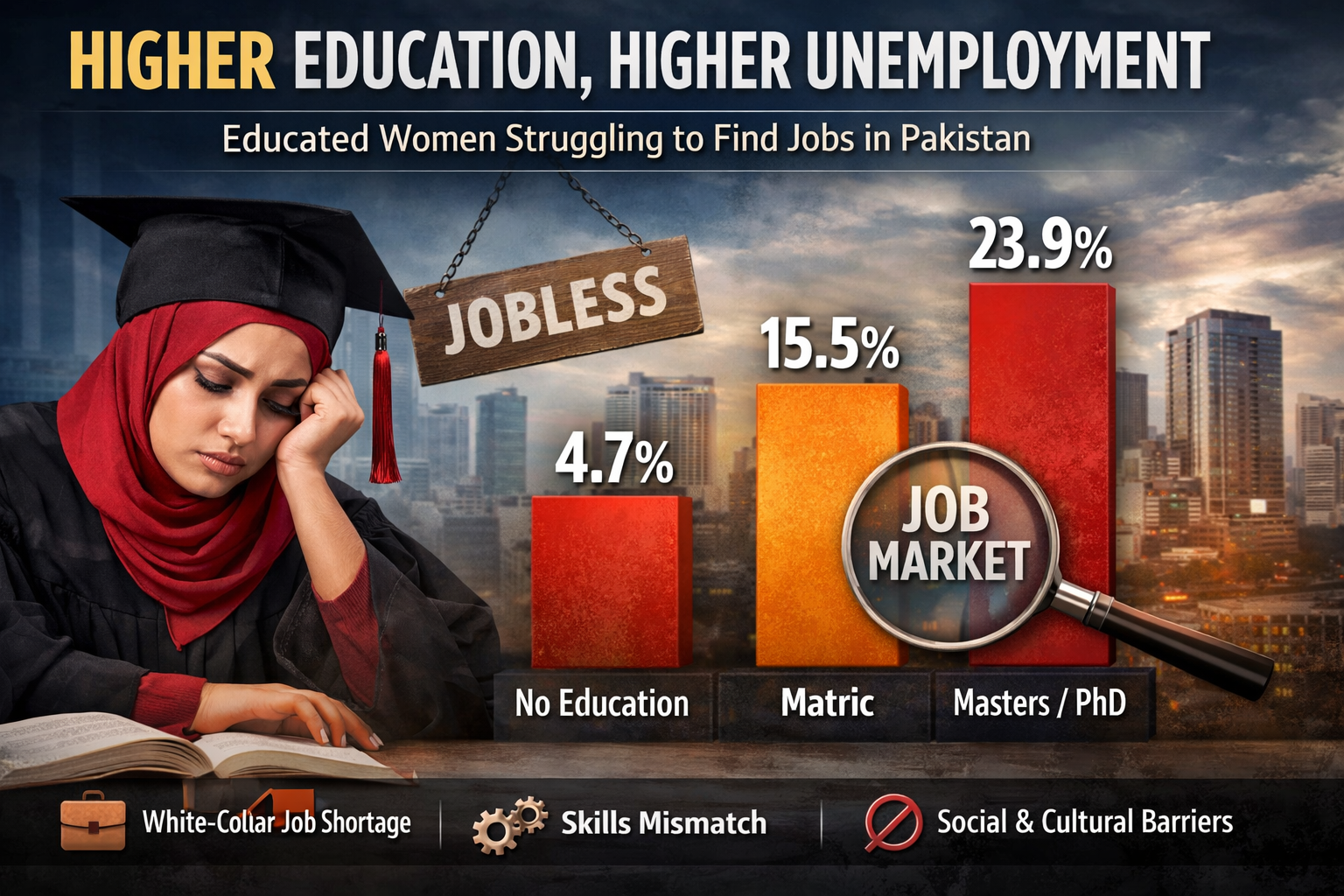
According to the survey, women without formal education experience relatively low unemployment, at just 4.7 percent. However, this figure nearly doubles to 9.0 percent among women with education below matriculation and climbs further to 15.5 percent for those who have completed matriculation.
The trend becomes even more concerning at higher levels of education. Women holding intermediate qualifications face an unemployment rate of 23.6 percent. Among university graduates, 23.8 percent remain unemployed, with the situation peaking at 23.9 percent for women holding master’s degrees, M.Phil., or PhD qualifications.
Experts warn that these numbers challenge the long-held belief that higher education automatically guarantees better employment prospects. Instead, structural issues in Pakistan’s Labour market appear to be the primary drivers of this paradox.
Analysts point to several key factors behind the rising unemployment among educated women. First, the country faces a chronic shortage of white-collar jobs, particularly in high-productivity sectors that can absorb skilled Labour. Second, a growing mismatch between academic curricula and market requirements leaves many graduates unprepared for available roles. Third, social norms, mobility restrictions, and safety concerns continue to limit women’s participation in the workforce.
Read More: https://informal.pk/sindh-education-alert-2026-exam-results-and-new-academic-calendar-finalized/
“While women’s access to education has improved dramatically over the past decade, the labour market has not evolved at the same pace,” said a labour economist. “The result is a widening gap between qualifications and opportunities.”
The PBS report underscores a critical policy challenge for Pakistan. Female enrollment and academic achievement have reached new highs, but the pace of job creation—especially in formal, knowledge-based, and high-skill sectors—remains slow. Without targeted interventions, experts fear the trend of rising unemployment among highly educated women could worsen, threatening broader economic growth and gender equity.
Policy recommendations include promoting private sector expansion, creating more jobs in knowledge-based industries, improving workplace safety and inclusivity, and establishing effective pathways that connect education to employment. Analysts also emphasize the importance of vocational training, mentorship programs, and incentives for employers to hire skilled women.
As Pakistan strives to boost economic participation and gender equality, the new Labour Force Survey serves as a stark reminder that education alone is not enough. Bridging the gap between academic achievement and meaningful employment opportunities will require urgent, coordinated action from policymakers, educational institutions, and industry leaders alike.
About The Author