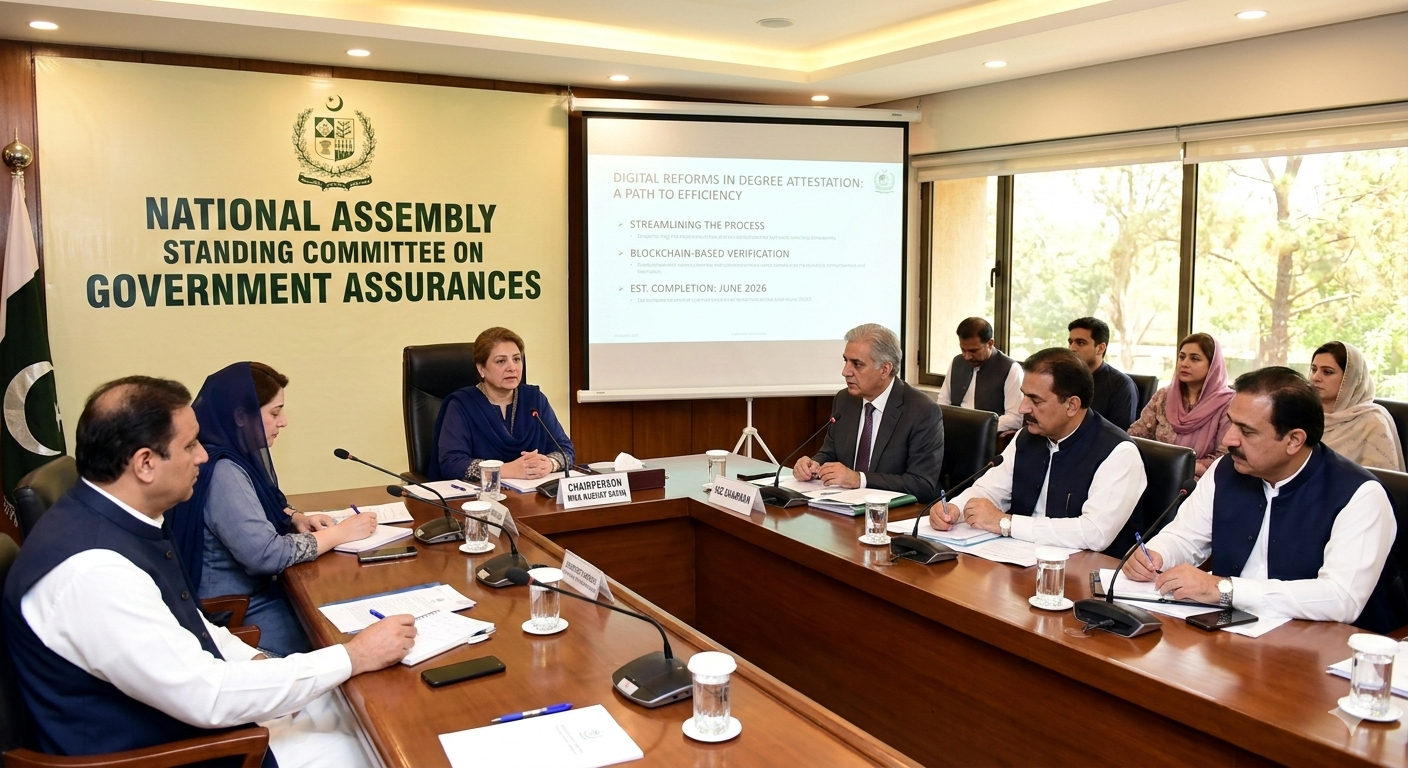
The National Assembly Standing Committee on Government Assurances on Friday called on the Higher Education Commission (HEC) to simplify and speed up the degree attestation process, citing delays and unnecessary financial burdens on students.
The meeting, chaired by MNA Nuzhat Sadiq, focused on reviewing the implementation of an earlier assurance given by the Education Minister regarding issues in degree attestation. Members of the committee stressed that the current system is too cumbersome, causing students to wait longer than necessary to have their degrees verified.
“The process from submission to completion should be as swift and efficient as possible,” said a committee member, highlighting the challenges faced by graduates who require attested degrees for employment and further education opportunities.
During the session, HEC Chairman informed the committee that a digital solution is underway. “As part of our ongoing digital transformation initiatives, we are developing a secure, blockchain-based system that will streamline the attestation process,” he said.
The chairman added that the system is expected to be operational before June 30, 2026, initially connecting HEC with 25 universities and the Attestation Directorate of the Ministry of Foreign Affairs. The committee also requested a joint presentation by HEC and the Ministry of Foreign Affairs to provide a detailed walkthrough of the attestation process, aiming to identify further areas for efficiency.
In addition to the attestation issue, members discussed concerns regarding the exclusion of newly introduced professional degrees from the Federal Employees Benevolent Fund fee reimbursement scheme. Degrees such as business data analysis, which have gained recognition from HEC, were reportedly not covered under the existing rules, leaving students without financial support.
The committee directed the Establishment Division to revise its regulations to include all professional degrees recognized by HEC and relevant accreditation councils. The secretary of the Establishment Division assured the committee that the rules would be amended accordingly, ensuring that graduates of new professional programs are eligible for reimbursement under the federal scheme.
Experts have welcomed these steps, noting that streamlining the attestation process could save both time and money for thousands of students. Currently, graduates often face delays of several weeks, or even months, while paying multiple fees at different stages of attestation. The introduction of a blockchain-based system is expected to reduce these delays and improve transparency.
“This is a positive move toward modernizing Pakistan’s higher education verification system,” said an education analyst, emphasizing that such reforms are crucial in an increasingly digital world.
The committee’s interventions signal a growing focus on student-friendly reforms in Pakistan’s higher education landscape. With the implementation of digital systems and updated reimbursement rules, students can expect a smoother, faster, and more financially accessible attestation process by mid-2026.
About The Author